Democratic maturity at Christiansborg
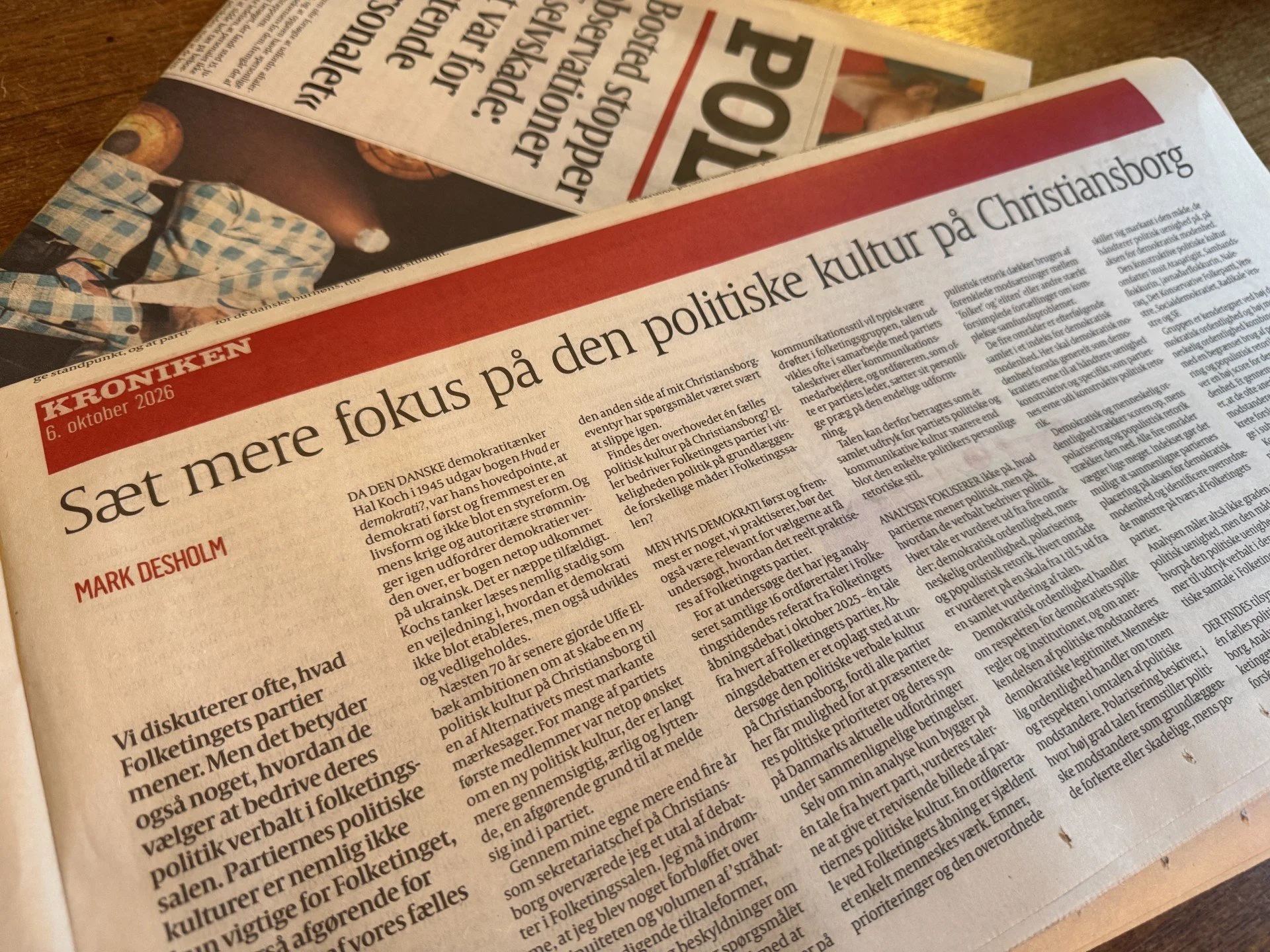
By Mark Desholm
Here the english version of my chronicle in Politiken 6 October 2026.
When the Danish democratic thinker Hal Koch published his book What Is Democracy? in 1945, his central argument was that democracy is first and foremost a way of life, not merely a form of government. And as wars and authoritarian currents once again challenge democracies around the world, the book has just been published in Ukrainian. That is hardly a coincidence. Koch’s ideas are still read as a guide to how democracy is not only established, but also developed and sustained.
Almost 70 years later, Uffe Elbæk made the ambition of creating a new political culture at Christiansborg one of the defining causes of the Alternative. For many of the party’s first members, the desire for a new political culture - one that was far more transparent, honest and willing to listen - was a decisive reason for joining the party.
During my own more than four years as head of the party secretariat at Christiansborg, I witnessed countless debates in the parliamentary chamber. I have to admit that I was somewhat astonished by the persistence and sheer volume of straw-man arguments, demeaning forms of address, eye-rolling and accusations of hidden motives. The question of political culture kept returning to me, and now that my time at Christiansborg is behind me, I have found it difficult to let go.
Is there really one common political culture at Christiansborg? Or do the parties represented in the Danish Parliament actually practise politics in fundamentally different ways in the parliamentary chamber?
But if democracy is first and foremost something we practise, voters should also have an interest in examining how it is actually practised by the parties in Parliament.
To investigate this, I analysed all 16 party spokesperson speeches recorded in the official parliamentary proceedings from the opening debate of the Danish Parliament in October 2025 - one speech from each party represented in Parliament. The opening debate is an obvious place to examine the verbal political culture at Christiansborg because all parties are given the opportunity, under comparable conditions, to present their political priorities and their views on Denmark’s current challenges.
Although my analysis is based on only one speech from each party, I consider the speeches to provide a reasonably representative picture of the parties’ political cultures. A spokesperson’s speech at the opening of Parliament is rarely the work of a single individual. The subjects, priorities and overall communication style will typically have been discussed within the parliamentary group; the speech is often developed in collaboration with the party’s speechwriter or communications staff; and the spokesperson, who is often the party leader, puts his or her personal stamp on the final version.
The speech can therefore be regarded as a collective expression of the party’s political and communicative culture rather than merely the personal rhetorical style of an individual politician.
The analysis focuses not on what the parties believe politically, but on how they conduct politics verbally. Each speech was assessed in four areas: democratic civility, interpersonal civility, polarisation and populist rhetoric. Each area was rated on a scale from 1 to 5 based on an overall assessment of the speech.
Democratic civility concerns respect for the rules and institutions of democracy and recognition of political opponents as democratically legitimate. Interpersonal civility concerns tone and respect in references to political opponents. Polarisation describes the extent to which a speech portrays political opponents as fundamentally wrong or harmful, while populist rhetoric covers the use of simplified oppositions between “the people” and “the elite”, or other highly reductive narratives about complex societal problems.
The four areas were then combined into an index of democratic maturity. Here, democratic maturity is understood in general terms as democracy’s capacity to handle disagreement constructively, and more specifically as the parties’ capacity for constructive political rhetoric.
Political disagreements are more frequently portrayed as a struggle between right and wrong people, or between “the people” and various “elites”.
Democratic and interpersonal civility increase the score, while polarisation and populist rhetoric reduce it. All four areas are weighted equally. The index makes it possible to compare where the parties fall on the axis of democratic maturity and to identify broader patterns across the parties represented in Parliament.
In other words, the analysis does not measure the degree of political disagreement, but the way in which political disagreement is expressed verbally in democratic debate in the parliamentary chamber.
There does not appear to be just one common political culture at Christiansborg. Instead, the analysis shows that the parties fall into three distinct political cultures, which differ markedly in how they handle political disagreement along the axis of democratic maturity.
The constructive political culture comprises Inuit Ataqatigiit, Sambandsflokkurin, Javnaðarflokkurin, Naleraq, the Conservative People’s Party, Venstre, the Social Democrats, the Social Liberal Party and the Socialist People’s Party.
This group is characterised by high levels of democratic and interpersonal civility combined with limited use of polarisation and populist rhetoric, resulting in a high democratic-maturity score. A recurring feature is that these parties often acknowledge the intentions or specific proposals of political opponents even when they disagree profoundly on substance.
Conflict primarily concerns solutions rather than motives. An illustrative quote from Aaja Chemnitz is: “It requires dialogue, and it also requires us to listen more than we speak.” Words that frequently recur among parties in this group include “together”, “community”, “cooperation”, “dialogue”, “respect”, “responsibility”, “trust”, “listen” and “development”.
The middle group comprises the Alternative, the Moderates, the Red-Green Alliance and Liberal Alliance. This group is likewise characterised by relatively high levels of democratic and interpersonal civility in its style of debate, but also by greater use of polarisation and populist rhetoric than the parties belonging to the constructive political culture, placing them around the middle of the axis.
The debate becomes more mobilising around individual issues or conflicts, but remains largely within the democratic rules of the game. An illustrative quote from Pelle Dragsted of the Red-Green Alliance is: “We should challenge each other robustly, while remembering to respect the democratic mandate.” Words particularly characteristic of this group include “responsibility”, “reforms”, “solutions”, “action”, “investment” and “future”.
The conflict-escalating political culture comprises the Denmark Democrats, the Danish People’s Party and the Citizens’ Party. This group is characterised by low levels of democratic and interpersonal civility combined with high levels of polarisation and populist rhetoric, resulting in a low democratic-maturity score.
Among the conflict-escalating parties, conflict more often shifts from the issue itself to the opponent and the opponent’s presumed hidden intentions. Political disagreements are more frequently portrayed as a struggle between right and wrong people, or between “the people” and various “elites”. An illustrative quote from Morten Messerschmidt of the Danish People’s Party is: “The promise was a lie.” Words characteristic of the conflict-escalating group include “lie”, “betrayal”, “spin” and “Islam”.
My analysis points to two particularly interesting findings. First, the three political cultures do not follow the traditional division between the left- and right-wing blocs. Parties from both sides of Parliament can be found among the most constructive parties as well as in the middle group. Second, the four North Atlantic parties occupy the very top positions in the analysis: all four belong to the constructive political culture, and three achieve the highest possible score on the democratic-maturity index.
The term political culture is widely used in public debate. Some politicians call for a new political culture at Christiansborg, commentators criticise the existing political culture, and voters often blame political culture for their disillusionment with politicians. Yet the term is rarely used with much precision, and even more rarely do we systematically investigate what it actually encompasses.
The analysis presented in this article is one attempt to make political culture the subject of more systematic investigation. The model is obviously not the only possible one, but it demonstrates that the concept can be operationalised and thereby provide a basis for an open discussion of how the parties represented in Parliament practise democracy in their everyday political work.
The analysis is not intended as a definitive ranking of good and bad parties. It is intended as a mirror for democracy, in which the parties represented in Parliament can see the political cultures they themselves help create through their style of debate.
One of the most interesting findings of the analysis is that it challenges one of the most widespread narratives about Danish politics. The most important axis in Parliament cannot be understood solely through the division between the left- and right-wing blocs, but also through different ways of conducting politics. Parties with widely differing political views may share a constructive political culture, while parties with similar political goals may differ markedly in their political practice.
This does not mean that ideological dividing lines have become less important. On the contrary, political disagreement is a fundamental driving force in a vibrant democracy. The analysis simply suggests that disagreement can be practised in different ways. Political culture thus becomes a distinct democratic axis for understanding Parliament. Where we traditionally describe parties according to their ideological positions, the analysis suggests that we can also understand them according to the way in which they practise democracy.
As noted above, Hal Koch described democracy as a way of life rather than merely a form of government. If we take that understanding seriously, political culture is not simply a matter of politicians and strategies, but of how democracy is practised in everyday life. The analysis suggests that this practice varies considerably among the parties represented in Parliament. Political culture therefore becomes not merely an ideal, but also a phenomenon that can be examined, discussed and perhaps even developed.
If political culture can be examined, the question is no longer simply what kind of society the parties wish to create. It is also how they wish to create it. Both should, in fact, matter to voters when they enter the polling booth.
Another finding gives reason for reflection. The four North Atlantic parties occupy the top positions in the analysis. The analysis cannot, of course, explain why, but the result raises an interesting question: Is there something about North Atlantic political traditions that encourages a more constructive political culture?
Several explanations are conceivable. Smaller societies such as Greenland and the Faroe Islands often mean shorter distances between politicians and citizens, and a greater likelihood that political opponents will also encounter one another outside the political arena. This may create stronger incentives to maintain a respectful tone and a cooperative political culture. But historical, cultural and parliamentary factors may also play a role.
Perhaps, however, it is not the North Atlantic parties that are the true outliers in the analysis, but rather the political culture among the Danish parties. If the analysis points to a genuine pattern, North Atlantic experience may offer an overlooked source of inspiration for developing a more constructive political culture at Christiansborg more broadly.
At the same time, there is good reason to be cautious about the conclusions. The analysis is based on one speech from each party, and political cultures are obviously not shaped by a single debate alone. Parties evolve over time, and the way politics is practised is also influenced by the individuals who represent them.
Naleraq provides an illustrative example. The analysis is based on the party’s current member of the Danish Parliament, but in my assessment its previous representative would probably have placed the party closer to the middle group. This underlines that political culture may reflect both party traditions and, of course, the people who embody them - perhaps particularly in smaller parties.
For precisely this reason, the analysis should be regarded as a first step rather than a final answer. A larger research project analysing party behaviour across several parliamentary sessions and incorporating multiple types of data could provide a much more nuanced picture of the political cultures at Christiansborg.
The analysis therefore makes no claim to provide definitive answers. Its primary ambition is to show that political culture can be investigated systematically and, hopefully, to inspire more comprehensive analyses in the future. Once a phenomenon can be measured, it can also be discussed, improved and, not least, developed more effectively.
If political culture can be examined, this also opens up a larger question: How do we create continuous feedback on the quality of our democracy rather than receiving it from voters only once every four years at a general election?
Today we measure everything from pupils’ well-being and the quality of hospital treatment to biodiversity and corporate accounts. Yet the quality of democratic practice is largely left to individual voters to assess on the basis of individual issues, media coverage and gut feeling.
Perhaps the time has therefore come to develop more systematic ways of examining democratic practice in Parliament. Not to hand out grades or shame parties and politicians, but to generate the knowledge and continuous feedback that any complex system needs if it is to learn and develop.
Democracy, after all, is not simply something we have. It is something we do, and therefore something we can become better at. Hal Koch described democracy precisely as a way of life whose culture develops and matures through experience, reflection and learning. Democracy is therefore a culture, and like any culture it must be cultivated - throughout society, of course, but especially at Christiansborg. Indsat markdown
