Political Parties Have Apparently Forgotten What They Stand For
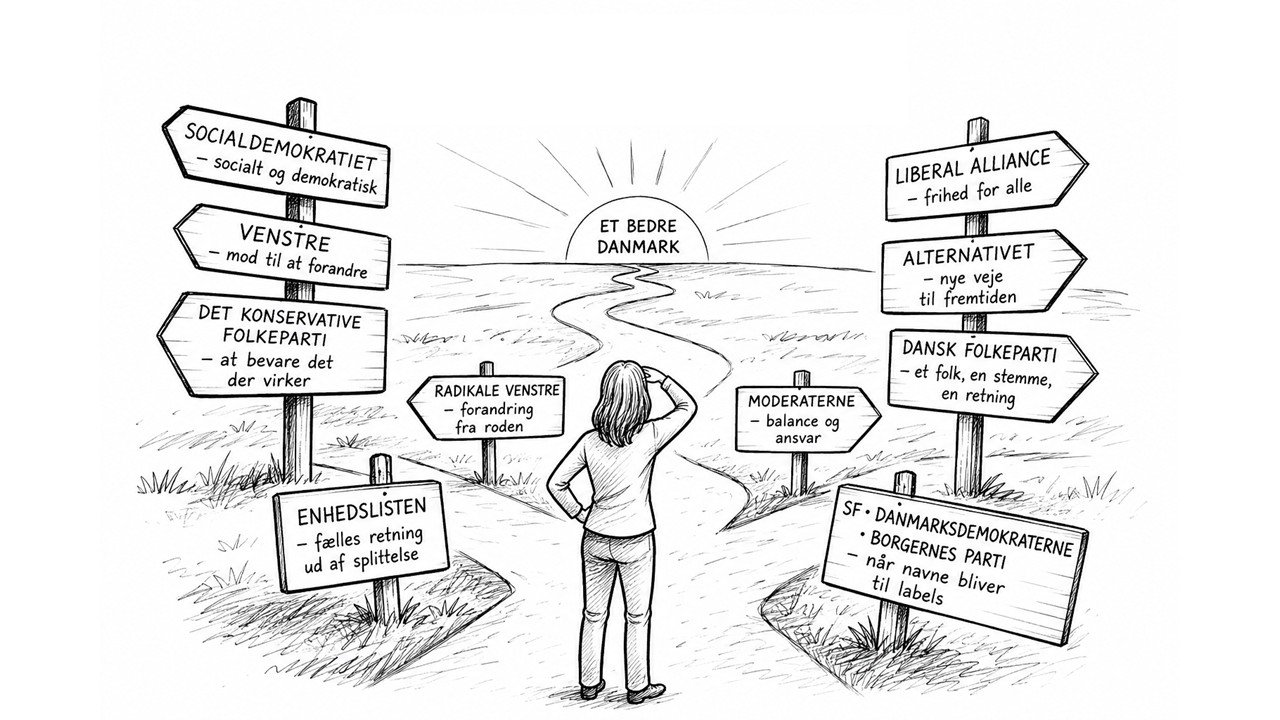
By Mark Desholm, PhD and former Secretary General of The Alternative. This chronicle was published in the Danish newspaper Politiken in May 2026.
Something does not add up in Danish politics right now. We have more parties, more colours and more political positions than ever before. And yet it seems increasingly difficult to understand what the parties actually stand for and where they want to lead society.
At the same time, we are facing some of the greatest challenges of our era. The climate crisis, the biodiversity crisis, growing inequality and global pressure on democracy all demand political answers that reach further than a single electoral cycle. They require direction, courage and ideas about how to create good lives in Denmark.
Perhaps the problem is not that we lack politics, but that political parties have lost touch with what they themselves are called and what they are supposed to represent. Party names are surely not accidental. They ought to be concentrated narratives about what a party wants for society. The question is whether they still are — and if not, whether they can become so again.
What if we actually took party names seriously? Not as historical labels, but as promises.
Take the Social Democrats. It is a name that almost demands to be split in two: social and democracy. The social points toward a society where inequalities are reduced and where those with the least benefit the most from the collective. Democracy points toward a form of popular government that is not merely administered, but constantly developed — where power is drawn ever closer to ordinary citizens.
That was precisely the project the Social Democrats once embodied. Workers lived under harsh and undignified conditions, and the labour movement helped create a society where rights replaced dependency. Together with the trade unions, they built the welfare state. Through cooperatives, they placed parts of the economy into the hands of workers themselves — a concrete attempt to make the social dimension more than politics: a lived practice.
Today, however, the social dimension has largely become administration. Inequality is growing, and in the pursuit of power across the political centre, the party has increasingly turned its attention away from those left behind as the express train of inequality speeds ahead. And the democratic dimension? It has become management. Efficient and disciplined, yes — but without the same ambition to deepen and renew democracy itself.
Once you split the name apart, the rupture becomes obvious: a party still called the Social Democrats, but which in practice is no longer especially social nor especially democratic in its transformative ambition.
Then there is Venstre — literally “Left” — although the name no longer reflects what we today understand as an ideological position. Originally it was a position of opposition. When the party was founded in 1870, they sat to the left of power: the landed aristocracy and the conservative establishment known at the time as Højre (“Right”). They represented farmers, liberals and those who demanded an end to privilege and to a system where the king appointed governments without regard for the will of parliament.
Where has that Venstre gone?
If “Venstre” were still to mean the courage to challenge power and reshape society, then the party ought to lead the great transformations of our time — not least in the agricultural sector, where its own historical roots run deepest.
A modern, and especially lobby-money-free, Venstre would not defend the status quo. It would help farmers through the necessary transition toward a sustainable agricultural model — away from a system that pushes both livestock and nature to their limits and toward a more balanced relationship with the environment.
And then we have the Conservative People’s Party.
Here the name is perhaps the most honest of all. To be conservative is, fundamentally, to be cautious. To preserve what works. Historically, that was their role: ensuring stability at times when other forces pushed for change.
The problem only arises when conservatism turns into stagnation — when the desire to preserve is no longer accompanied by the ability to distinguish between what deserves preservation and what urgently needs to change.
Together, these three parties — the Social Democrats, Venstre and the Conservatives — built the Denmark we still inhabit today. But increasingly they resemble parties that merely administer what they once created, rather than parties preparing us for the future that is coming.
The colours are still there — red, blue and blue-green — but they have faded. The question is no longer who these parties once were. The question is whether they still dare to become what their own names naturally commit them to being.
If we take party names seriously, then the political centre ought to be the most exciting place in Danish politics. Here we find the Social Liberals and the Moderates.
The word “radical” means going to the root of things. Wanting fundamental change. That was exactly the ambition when the Social Liberal Party was founded as a breakaway from Venstre: less militarism, more social justice and a social-liberal vision attentive to those left outside the system.
But the party was also something else: a centrist party with direction. It could choose sides. It could pull Denmark toward red or blue depending on what it believed best served society. It shifted colours — but never without having a colour of its own.
Today, however, the radical dimension has become harder to spot. What was once an act of opposition has often become compromise. The party can still choose sides, but it is less clear what larger direction those choices serve.
And then there are the Moderates.
The Moderates have made the centre itself into a political project. They call themselves purple — a mixture of red and blue. Not a choice between directions, but a fusion of them. Where the Social Liberals alternated between red and blue alliances, the Moderates attempt to embody both simultaneously. Yet already after a single term in government, the purple seems to drift toward red.
The risk of positioning oneself permanently in the centre is not only compromise, but also loss of direction and ideological clarity. How do you create deep societal change if you are constantly balancing between opposing worldviews?
Some party names promise not balance, but something far greater: freedom, alternatives and new paths. Here we find Liberal Alliance and The Alternative.
Take Liberal Alliance. “Liberal” is one of the most frequently used — and diluted — words in politics. At its core, however, liberalism is about freedom: freedom from unnecessary state interference, freedom to think, speak and live one’s life.
But today the liberal dimension of Liberal Alliance is often reduced to economics: tax cuts, smaller government and more market forces. The blue colour remains sharp — but also narrow. Because freedom in the 21st century must also mean freedom from climate collapse and extreme inequality. Freedom from structures that make some people’s choices merely theoretical.
When freedom becomes too narrow and reserved for too few, it also becomes less free.
Then there is The Alternative.
A name that is perhaps even more demanding. The party was born as an opposition to “business as usual” and with the ambition of rethinking society from the ground up. Its neon-green visual identity radiated novelty, experimentation and difference. Today the green remains — but softer, more muted and slightly dustier.
And this raises the same question as the name itself: how alternative is The Alternative today?
I was once part of The Alternative myself. We often said that we were not bound by ideology, but by values. Yet perhaps the real difference is not whether one has noble values, but whether one succeeds in weaving them into a coherent and timely story about society.
What remains are two parties carrying grand promises — freedom and alternativism — yet both risk losing substance along the way. Perhaps what they lack is neither sharper slogans nor more individual policy proposals, but compelling narratives about the kind of society they actually want to create — narratives that align with the promises embedded in their names.
One can disagree deeply with the Danish People’s Party. I certainly do. But one thing cannot be taken away from them: they understand what a party name is.
The Danish People’s Party is exactly what the name suggests: a party for a particular people, defined nationally, centred on Danish culture, identity and interests.
One may reject that vision entirely, but there is a clear coherence between the name, the narrative and the politics. The same applies to the colour yellow: unmistakable, bold and uncompromising. While other parties drift between colours and positions, the Danish People’s Party remains loyal to its own name and meaning. Perhaps that is precisely why it still retains a loyal voter base.
Finally, there are the parties where it becomes increasingly difficult to understand what the names actually promise.
The Red-Green Alliance originally made sense historically. It was a coalition of smaller left-wing factions attempting to create unity from division. But over time that story fades. Internal divisions still exist, and outwardly the “unity” can appear more like organisational compromise than political clarity.
The Socialist People’s Party combines ideology and popular appeal in its name. Socialism has not disappeared from the party, but tensions arise when it follows the Social Democrats toward the political centre in pursuit of government participation.
The Denmark Democrats place “Denmark” at the centre. But which Denmark? The name suggests broad national representation, while the politics often focus on particular regions and voter groups.
And then there is The Citizens’ Party — a name promising community and representation of “ordinary citizens.” Yet when a party is quickly reduced to a single parliamentary member, the contrast becomes difficult to ignore. There is often a long distance between an inclusive name and a sustainable political project.
Political power tends to wear parties down. But perhaps that is not inevitable.
What if parties spent their time in government doing what originally earned them public support: improving life for broad sections of society? Not merely as an electoral strategy, but as genuine political transformation.
Many parties that once fought power now possess it. That requires something new of them.
What are political parties actually for?
Increasingly, that question seems to have been replaced by another: how do we hold on to power at any cost?
When that happens, it is not only party names that begin to lose meaning. Colours fade as well. They become less distinct, less binding and more adaptable. And if political direction disappears, what are voters left to orient themselves by?
Perhaps this helps explain parts of today’s democratic crisis: declining party membership, growing political disillusionment and weakening trust in the political system. Democracy itself has not become less important. But it has perhaps become harder to see where we are heading together — and how political parties intend to lead us there.
If politics is to regain direction, parties must rediscover their narratives. Not merely in the form of slogans and isolated policy proposals, but as coherent visions for how to build a society capable of confronting the crises of our age while still allowing people to live meaningful and dignified lives.
And who knows? Perhaps there is political gold hidden in the very names parties once chose for themselves. Perhaps those names simply need to be reread — or reinvented. Not as branding in the pursuit of power, but as promises to the citizens they were created to represent.
